Pay for a Promise
Pay for a promise.
Make an offer: your promise to pay, in exchange for the promise you ask for. When the other side accepts, the promises are exchanged. You pay them directly within the number of days your offer sets. Both sides keep a record of what was promised, when, and what each side reports about the payment.
Coming soon. We’re starting with a small group of lawyers and their clients.

How it works
Two people, two promises. The asker offers money. The promiser makes a promise in return.
Make an offer
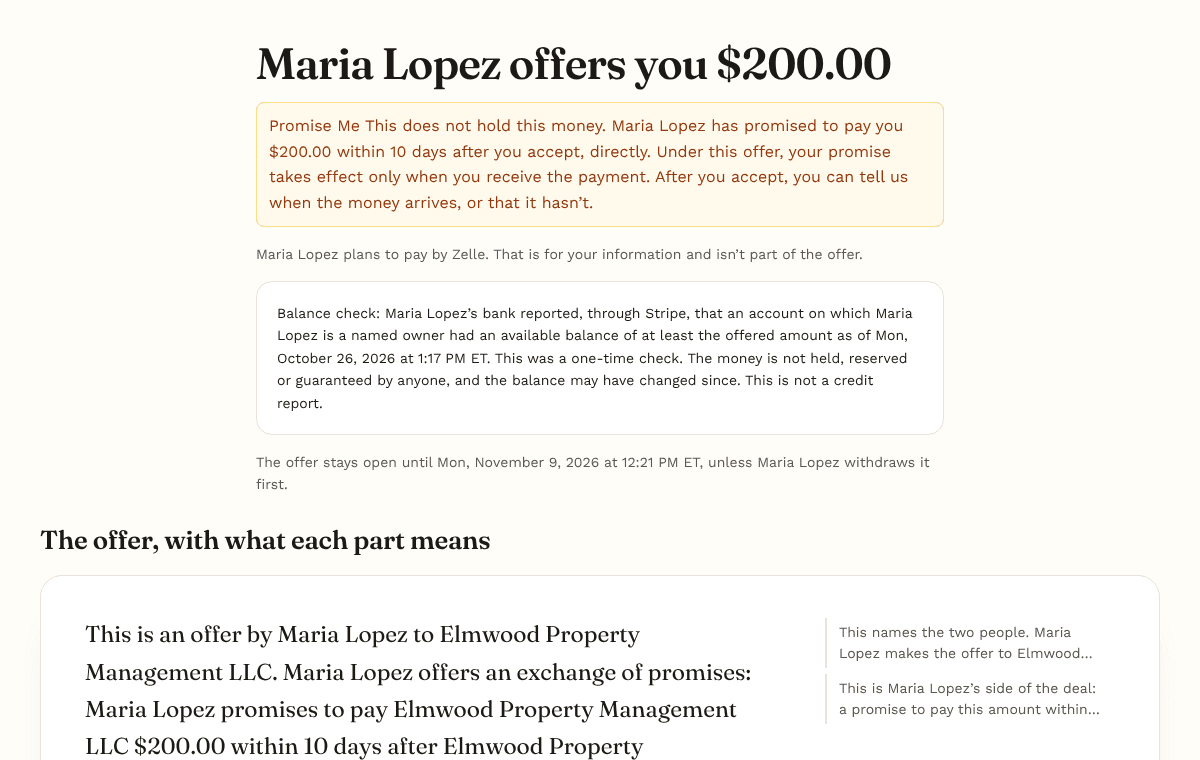
Choose the amount and how many days you have to pay after they accept. For the promise, start from our standard release of claims and edit it however you like. Pay a small fee. If you like, show the other side you have the money with a one-time balance check.
Send the link
The other person sees your full offer and the promise it asks of them. They can accept it as written or send back a counteroffer.
Accept, then pay
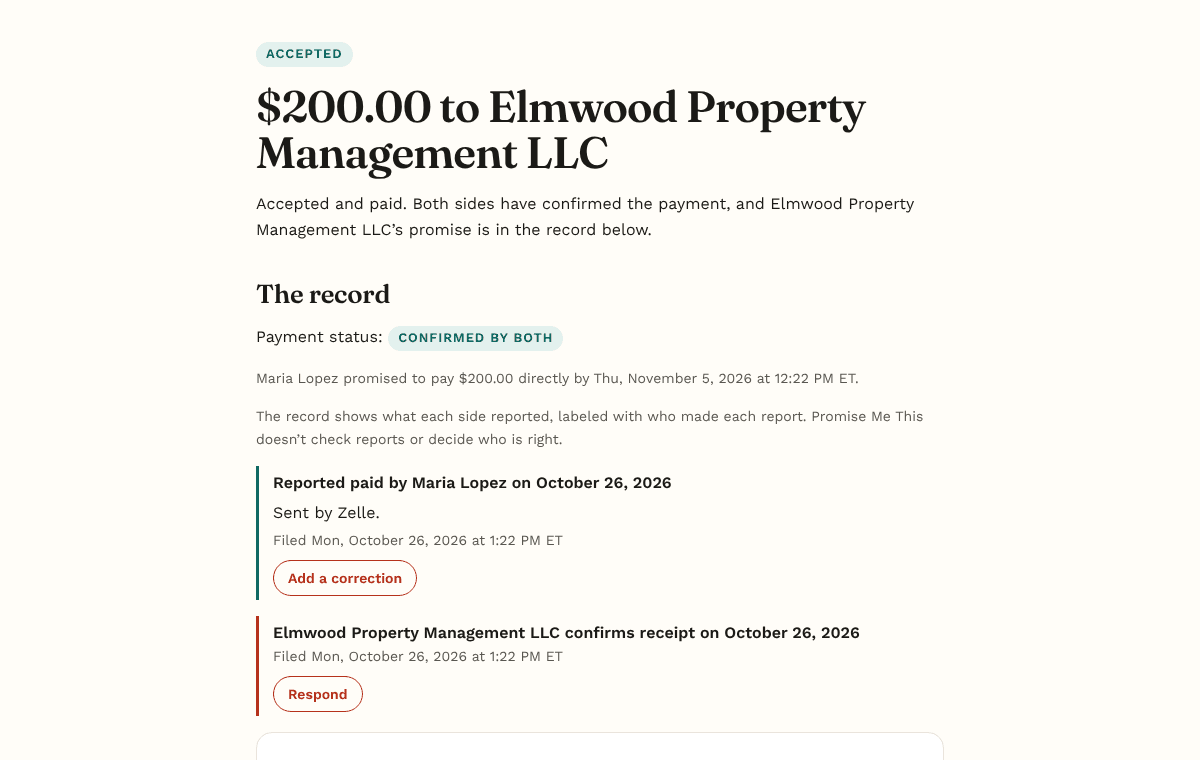
When they accept, they tell you how they’d like to be paid, and your page shows their details with a “Pay now” button. You pay them directly, the way they ask (Zelle, Venmo, PayPal, Cash App or check). Under our standard wording, their promise takes effect when they receive the payment. Both sides report the payment and get a record of exactly what was promised and when.
Who it’s for
Lawyers and their clients resolving disputes, and anyone who wants to settle a disagreement cleanly, with the promise, the payment and the record in one place.
- A company offers a former vendor $12,000 for a release of claims over a terminated contract.
- A contractor offers a homeowner $4,000 for a release of claims over a disputed renovation.
- A business offers a customer $500 for a release of claims over a damaged shipment.
- A property owner offers a neighbor $2,000 to drop a claim over a fallen tree.
Lawyers can set up offers for their clients. The client pays the other side directly, so the lawyer never has to hold or move the money.
Need a release from several people over the same matter? You can send each of them an offer at once, adding them one by one or from a spreadsheet, and each person gets their own offer and record.
For people without a lawyer, too
You don’t need a lawyer or a big company behind you. Under our standard wording, the promiser’s promise takes effect only when the promiser is paid, so nobody gives up a claim for money that never arrives. Any change the asker makes to that wording is marked for the promiser to see. The asker can show the money is there with a one-time balance check. Both sides record the payment, so if anyone later disagrees about what was promised or paid, there’s one record to look at.
- After moving out, a tenant offers her former landlord $200 to settle its $600 claim for cleaning costs.
- After a fender bender, one driver offers the other $900 to settle the damage directly.
- A dog owner offers a neighbor who was bitten $750 toward medical bills for a release of claims.
- A private seller offers the buyer of a used car $1,200 back over a problem that wasn’t disclosed.
- A wedding photographer who missed the ceremony offers the couple $1,500 for a release of claims.
- A contractor whose shower installation leaked into the ceiling below offers the homeowner $1,000 for a release of claims.

What it isn’t
- Not debt settlement, debt relief or debt collection
- Offers here are for settling disputed claims, not for paying off bills or debts nobody disputes. We don’t negotiate for anyone or collect for anyone, and debt settlement, debt relief and debt collection businesses may not use the service.
- Not a payment service
- We never hold, receive or move anyone’s money. The asker pays the promiser directly.
- Not a law firm
- We don’t give legal advice or draft agreements for you. Our standard wording is a starting point, and we don’t explain or check changes to it; talk to a lawyer about whether it fits your situation.
- No guarantee of enforceability
- We record exactly what was promised, by whom and when. Whether a promise is enforceable depends on the law that applies, and we don’t guarantee it.
Pricing
One fixed fee per offer, paid by the asker and shown before you make the offer. The promiser pays nothing. See pricing

Questions
- When does the other person get paid?
- Within the number of days the offer sets, counted from acceptance. You pay them directly, the way they ask (Zelle, Venmo, PayPal, Cash App or check), using the details they give on the offer’s page. Then each of you can record that the payment was made and received.
- Can I take the offer back?
- Yes, at any time before it’s accepted. If the offer isn’t accepted, the fee comes back, less $5.00 to cover costs.
- What if they never respond?
- The offer ends when its time runs out, and your fee comes back, less $5.00 to cover costs.
- Can they make a counteroffer?
- Yes. You then decide whether to accept it, keep your original offer open, or withdraw it.
- Can I write my own promise?
- Yes, within our rules on acceptable use. The other person sees the full text before accepting.
- Does Promise Me This hold the money?
- No. The money stays with you until you pay the other side. We record the offer, the acceptance and what each side reports about the payment.
- Why not just send the other person an email?
- You can. What an offer here adds is standard wording with a note on what each sentence does, a clear offer and a clear acceptance, one record both sides see, and reminders and reports about the payment afterward.
- Is a promise made here enforceable?
- Each offer is set up as an ordinary contract offer: a promise to pay in exchange for a promise, which the other person accepts by making their promise. Whether a particular promise is enforceable depends on the law and your circumstances, so we can’t promise it. We give both sides a tamper-evident record of the offer, the acceptance and what each side reports about the payment.